Developing Future Teachers’ Information Competence in Inclusive Education: A Comparative Study of Uzbekistan and Indonesia within the WFIEd Framework
DOI:
https://doi.org/10.61227/arji.v8i1.726Keywords:
inclusive education, future teachers, information competence, information literacy, comparative education, Indonesia, Uzbekistan, WFIEdAbstract
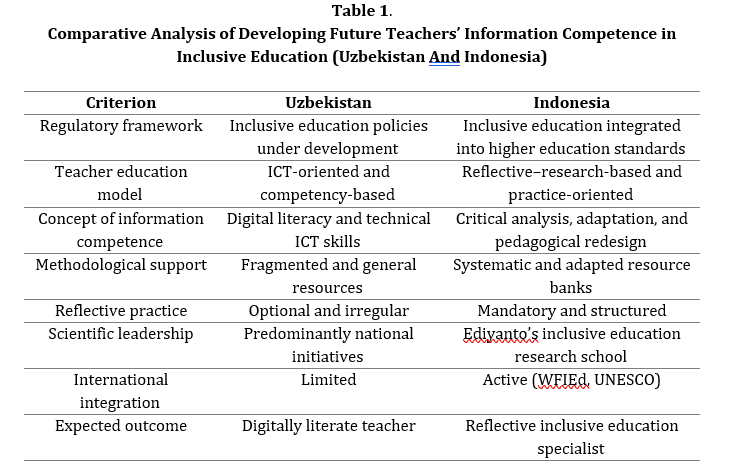
This study investigates the development of future teachers’ information competence in inclusive education settings through a comparative analysis of Uzbekistan and Indonesia. Information competence is conceptualized as an integrative construct comprising cognitive, operational–practical, motivational–value, and reflective components. Using theoretical analysis and comparative pedagogy methods, the research highlights significant differences between national teacher education models. The Indonesian experience, particularly the reflective–research-based approach advanced by Professor Ediyanto Ediyanto at Universitas Negeri Malang, demonstrates a systematic integration of information analysis, adaptation, and pedagogical decision-making. The WFIEd framework is positioned as a mechanism for international methodological alignment. Based on the findings, the article proposes evidence-based recommendations for improving methodologies for developing information competence among future teachers in inclusive education contexts.
Downloads
References
Anderson, T., & Dron, J. (2011). Three generations of distance education pedagogy. International Review of Research in Open and Distributed Learning, 12(3), 80–97.
https://doi.org/10.19173/irrodl.v12i3.890
Bates, T. (2019). Teaching in a digital age: Guidelines for designing teaching and learning. Vancouver: BCcampus.
Bell, D. (1973). The coming of post-industrial society. New York: Basic Books.
Booth, T., & Ainscow, M. (2011). Index for inclusion: Developing learning and participation in schools (3rd ed.). Centre for Studies on Inclusive Education.
Creswell, J. W., & Poth, C. N. (2018). Qualitative inquiry and research design: Choosing among five approaches (4th ed.). Thousand Oaks, CA: SAGE Publications.
Ediyanto, E. (2018). Teacher readiness for inclusive education in Indonesia. International Journal of Inclusive Education, 22(7), 734–748.
https://doi.org/10.1080/13603116.2017.1412510
Ediyanto, E., & Kawai, N. (2023). The measurement of teachers' attitudes toward inclusive education: An empirical study in East Java, Indonesia. Cogent Education, 10(2), 2229014. https://doi.org/10.1080/2331186X.2023.2229014
Ediyanto, E., Kustawan, D., & Suryani, N. (2020). Developing teachers’ reflective competence for inclusive classrooms. International Journal of Inclusive Education, 24(9), 987–1003.
https://doi.org/10.1080/13603116.2018.1514750
European Agency for Special Needs and Inclusive Education. (2018). Teacher education for inclusion. Brussels.
Khimmataliev, D. O. (2022). Developing professional competence of future teachers in inclusive education settings. Pedagogical Education and Innovations, 4(2), 15–22.
Khimmataliev, D. O., & Omonova, N. P. (2023). Developing information competence of future teachers in a digital inclusive learning environment. Modern Education, 6(1), 28–35.
Méndez, V. G., Suelves, D. M., Méndez, C. G., Ramon-Llin Mas, J. A., & Romero, J. (2023). Future teachers facing the use of technology for inclusion: A view from the digital competence. Education and Information Technologies, 28, 9305–9323. https://doi.org/10.1007/s10639-022-11105-5
Meyer, A., Rose, D. H., & Gordon, D. (2014). Universal design for learning: Theory and practice. Wakefield, MA: CAST.
OECD. (2019). Trends shaping education 2019. Paris: OECD Publishing.
OECD. (2021). Digital education outlook: Pushing the frontiers with AI, blockchain and robots. Paris: OECD Publishing.
Omonova, N. P. (2021). Methodological foundations of teacher activity in inclusive education. Special Pedagogy and Psychology, 3(1), 41–48.
Omonova, N. P., & Khimmataliev, D. O. (2024). Developing future teachers’ information competence in inclusive education contexts. Journal of Engineering Science and Technology, 19(2), 112–123.
Robert, I. V. (2014). Information educational environment: Theory and practice. Moscow: BINOM.
Sahlberg, P. (2015). Finnish lessons 2.0: What can the world learn from educational change in Finland? New York: Teachers College Press.
Schön, D. A. (1983). The reflective practitioner: How professionals think in action. New York: Basic Books.
UNESCO. (2017). A guide for ensuring inclusion and equity in education. Paris: UNESCO Publishing.
UNESCO. (2020). Global education monitoring report: Inclusion and education – All means all. Paris: UNESCO.
World Federation of Inclusive Education (WFIEd). (2021). International guidelines for inclusive teacher education. WFIEd Publications.
Zenkina, S. V. (2016). Information and communication educational environment as a pedagogical system. Pedagogika, 5, 34–42.
Additional Files
Published
How to Cite
Issue
Section
License
Copyright (c) 2026 Authors

This work is licensed under a Creative Commons Attribution 4.0 International License.
Similar Articles
- Ahmad Kamalul Fikri, Dhion Meitreya Vidhiasi, Konstruksi Wacana Media Online terhadap Program Makan Bergizi Gratis di Lembaga Pendidikan Indonesia Tahun 2026 , Action Research Journal Indonesia (ARJI): Vol. 8 No. 2 (2026): Action Research Journal Indonesia (ARJI)
- Ahmad Dimyati Ridwan, Muhamad Ridwan Sudaryat, Muhamad Parhan, Sofwan Harun Al Rasyid, Sephia Musyaffa Nur Aulia, Implikasi Pedagogis Pragmatisme Religius dan Eksistensialisme Digital: Studi Fenomenologis Narasi #KaburAjaDulu pada Anak Muda Muslim , Action Research Journal Indonesia (ARJI): Vol. 8 No. 1 (2026): Action Research Journal Indonesia (ARJI)
- Nur Arifuddin, Nanang Hermawan, Pendidikan Literasi Politik dan Tantangan Post-truth dalam Ruang Publik Indonesia Pasca Pemilihan Umum 2024 , Action Research Journal Indonesia (ARJI): Vol. 7 No. 4 (2025): Action Research Journal Indonesia (ARJI)
- Joy Amaechi Okeke - Ezeanyanwu, Sylvia Chinwe Okere, Effectiveness of Internal Control Measures for Preventing Employee’s Fraud in Public Secondary Schools in Ebonyi State Nigeria , Action Research Journal Indonesia (ARJI): Vol. 7 No. 2 (2025): Action Research Journal Indonesia (ARJI)
- Hanifah Hanifah, Penggunaan Media Video dalam Meningkatkan Hasil Belajar Kognitif Siswa Kelas VIII MTS Negeri 4 Cirebon Pada Mata Pelajaran IPS Materi Kedatangan Bangsa Bangsa Barat Ke Indonesia , Action Research Journal Indonesia (ARJI): Vol. 3 No. 3 (2021): Action Research Journal Indonesia (ARJI)
- Nabilla Marsya Nada, Rafi Andika, Pitra Arya Oktama, Nurul Rahmad Ramadhan, Nurpitri Ikmalia, Nurul Azizah, The Construction of Religious Identity Among Islamic Education Students Amid the Current of Modern Islamic Thought , Action Research Journal Indonesia (ARJI): Vol. 7 No. 3 (2025): Action Research Journal Indonesia (ARJI)
- Jihan Novita Sari, Nur Hiqma , Niken Aufa Rafiki, Nur Aisyah Finanda Harahap, Nirwana Damayanti, Nurul Azizah, Innovations in 21st Century Education: An Experimental Investigation of the Effect of Problem Based Learning on Students’ Learning Autonomy , Action Research Journal Indonesia (ARJI): Vol. 7 No. 3 (2025): Action Research Journal Indonesia (ARJI)
- Shukuru Lukas, Prospery M. Mwila, Status of Kiswahili Remedial Teaching Exercise in Public Secondary Schools in Temeke Municipality, Tanzania , Action Research Journal Indonesia (ARJI): Vol. 7 No. 2 (2025): Action Research Journal Indonesia (ARJI)
- Franklin Nnanna Ibe, Bernadette A. Ezeliora, Chinyere F. Okafor, Effect of Think-Pair-Share Instructional Strategy on Secondary School Students’ Academic Achievement in Chemistry , Action Research Journal Indonesia (ARJI): Vol. 6 No. 4 (2024): Action Research Journal Indonesia (ARJI)
- Nurul Azizah, Nachua Qinanthi, Nadia Eka Sauwitri, Lepi Maya Sari, Mona Agustina, Anggraini Pratiwi, The Implementation of the Blended Learning Model: An Effort to Enhace Analytical Skills (C4) on the Topic of Exemplary Indonesian Islamic Scholars , Action Research Journal Indonesia (ARJI): Vol. 7 No. 2 (2025): Action Research Journal Indonesia (ARJI)
<< < 2 3 4 5 6 7 8 9 10 11 > >>
You may also start an advanced similarity search for this article.
Most read articles by the same author(s)
- Nilufar Parda Qizi Omonova, Developing Information Work Competence of Future Primary Education Teachers: An Integrative Pedagogical Model , Action Research Journal Indonesia (ARJI): Vol. 8 No. 2 (2026): Action Research Journal Indonesia (ARJI)
|
Support > Partner > Tools > Indexing
|
Contact > Adrees > Website |
Statistic |
For Author > Template
|
 |
|---|

Creative Commons Attribution-ShareAlike 4.0 International License CC BY-NC-SA 4.0
|