Developing Future Teachers’ Information Competence in Inclusive Education: A Comparative Study of Uzbekistan and Indonesia within the WFIEd Framework
DOI:
https://doi.org/10.61227/arji.v8i1.726Keywords:
inclusive education, future teachers, information competence, information literacy, comparative education, Indonesia, Uzbekistan, WFIEdAbstract
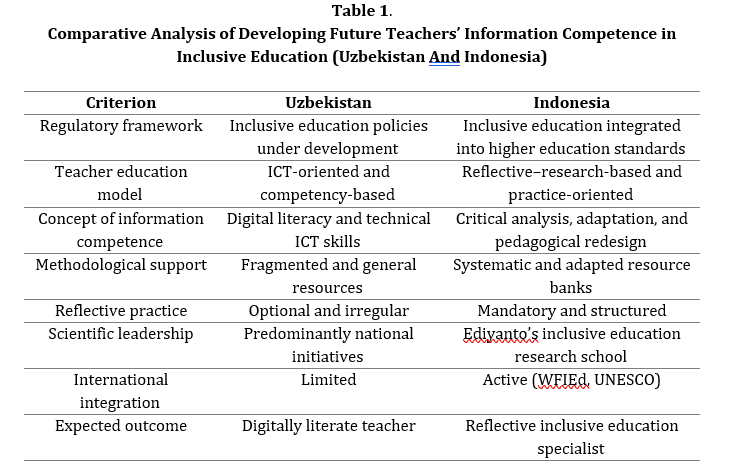
This study investigates the development of future teachers’ information competence in inclusive education settings through a comparative analysis of Uzbekistan and Indonesia. Information competence is conceptualized as an integrative construct comprising cognitive, operational–practical, motivational–value, and reflective components. Using theoretical analysis and comparative pedagogy methods, the research highlights significant differences between national teacher education models. The Indonesian experience, particularly the reflective–research-based approach advanced by Professor Ediyanto Ediyanto at Universitas Negeri Malang, demonstrates a systematic integration of information analysis, adaptation, and pedagogical decision-making. The WFIEd framework is positioned as a mechanism for international methodological alignment. Based on the findings, the article proposes evidence-based recommendations for improving methodologies for developing information competence among future teachers in inclusive education contexts.
Downloads
References
Anderson, T., & Dron, J. (2011). Three generations of distance education pedagogy. International Review of Research in Open and Distributed Learning, 12(3), 80–97.
https://doi.org/10.19173/irrodl.v12i3.890
Bates, T. (2019). Teaching in a digital age: Guidelines for designing teaching and learning. Vancouver: BCcampus.
Bell, D. (1973). The coming of post-industrial society. New York: Basic Books.
Booth, T., & Ainscow, M. (2011). Index for inclusion: Developing learning and participation in schools (3rd ed.). Centre for Studies on Inclusive Education.
Creswell, J. W., & Poth, C. N. (2018). Qualitative inquiry and research design: Choosing among five approaches (4th ed.). Thousand Oaks, CA: SAGE Publications.
Ediyanto, E. (2018). Teacher readiness for inclusive education in Indonesia. International Journal of Inclusive Education, 22(7), 734–748.
https://doi.org/10.1080/13603116.2017.1412510
Ediyanto, E., & Kawai, N. (2023). The measurement of teachers' attitudes toward inclusive education: An empirical study in East Java, Indonesia. Cogent Education, 10(2), 2229014. https://doi.org/10.1080/2331186X.2023.2229014
Ediyanto, E., Kustawan, D., & Suryani, N. (2020). Developing teachers’ reflective competence for inclusive classrooms. International Journal of Inclusive Education, 24(9), 987–1003.
https://doi.org/10.1080/13603116.2018.1514750
European Agency for Special Needs and Inclusive Education. (2018). Teacher education for inclusion. Brussels.
Khimmataliev, D. O. (2022). Developing professional competence of future teachers in inclusive education settings. Pedagogical Education and Innovations, 4(2), 15–22.
Khimmataliev, D. O., & Omonova, N. P. (2023). Developing information competence of future teachers in a digital inclusive learning environment. Modern Education, 6(1), 28–35.
Méndez, V. G., Suelves, D. M., Méndez, C. G., Ramon-Llin Mas, J. A., & Romero, J. (2023). Future teachers facing the use of technology for inclusion: A view from the digital competence. Education and Information Technologies, 28, 9305–9323. https://doi.org/10.1007/s10639-022-11105-5
Meyer, A., Rose, D. H., & Gordon, D. (2014). Universal design for learning: Theory and practice. Wakefield, MA: CAST.
OECD. (2019). Trends shaping education 2019. Paris: OECD Publishing.
OECD. (2021). Digital education outlook: Pushing the frontiers with AI, blockchain and robots. Paris: OECD Publishing.
Omonova, N. P. (2021). Methodological foundations of teacher activity in inclusive education. Special Pedagogy and Psychology, 3(1), 41–48.
Omonova, N. P., & Khimmataliev, D. O. (2024). Developing future teachers’ information competence in inclusive education contexts. Journal of Engineering Science and Technology, 19(2), 112–123.
Robert, I. V. (2014). Information educational environment: Theory and practice. Moscow: BINOM.
Sahlberg, P. (2015). Finnish lessons 2.0: What can the world learn from educational change in Finland? New York: Teachers College Press.
Schön, D. A. (1983). The reflective practitioner: How professionals think in action. New York: Basic Books.
UNESCO. (2017). A guide for ensuring inclusion and equity in education. Paris: UNESCO Publishing.
UNESCO. (2020). Global education monitoring report: Inclusion and education – All means all. Paris: UNESCO.
World Federation of Inclusive Education (WFIEd). (2021). International guidelines for inclusive teacher education. WFIEd Publications.
Zenkina, S. V. (2016). Information and communication educational environment as a pedagogical system. Pedagogika, 5, 34–42.
Additional Files
Published
How to Cite
Issue
Section
License
Copyright (c) 2026 Authors

This work is licensed under a Creative Commons Attribution 4.0 International License.
Similar Articles
- Ira Sri Rahayu, Pratik Hari Yuwono, Implementasi Pendidikan Karakter Jujur Melalui Watak Bawor Banyumasan Di Sekolah Dasar Negeri 2 Tanjung , Action Research Journal Indonesia (ARJI): Vol. 7 No. 3 (2025): Action Research Journal Indonesia (ARJI)
- Ade Erlangga, Imam Syafei, Erlina Erlina, Pengelolaan Eco-Pesantren dalam Membangun Pendidikan Pesantren Ramah Lingkungan di Pondok Pesantren Darunnajah Lampung Timur dan Pondok Pesantren Darul Muttaqin Metro , Action Research Journal Indonesia (ARJI): Vol. 7 No. 3 (2025): Action Research Journal Indonesia (ARJI)
- Satria Gigih Jatikusumo, Hera Heru Sri Suryanti, Elinda Rizkasari, Analisis Penguatan Karakter Disiplin dan Tanggung Jawab melalui Seni Karawitan SDN Purwaprajan Surakarta Tahun Ajaran 2025 , Action Research Journal Indonesia (ARJI): Vol. 7 No. 3 (2025): Action Research Journal Indonesia (ARJI)
- Nurul Nikmatul Imda, Ahmad Saefudin, Application of Learning Model Student Teams Achievement Divisions (STAD) in Developing the Attitude of Cooperation and Creativity of Students in the Subjects of Islamic Religious Education and Ethics in Class V SD Negeri 3 Bulungan , Action Research Journal Indonesia (ARJI): Vol. 7 No. 4 (2025): Action Research Journal Indonesia (ARJI)
- Nanang Hermawan, Membangun Mindset Kewirausahaan Inklusif: Strategi Pendidikan Vokasi dalam Menjawab Kesenjangan Sosial dan Ekonomi , Action Research Journal Indonesia (ARJI): Vol. 7 No. 3 (2025): Action Research Journal Indonesia (ARJI)
- Kharisma Idola Arga, Dyanti Mahrunnisya, Sari Sari, Salsabila Millatul Ulya, Aura Putri Deyustiya, Kelas Cerdas Finansial: Program Edukasi Literasi Keuangan bagi Siswa SMA Adiguna Bandar Lampung , Action Research Journal Indonesia (ARJI): Vol. 7 No. 3 (2025): Action Research Journal Indonesia (ARJI)
- Nurhayati Nurhayati, Rifqi Khairul Anam, Implementasi Metode Al-Miftah Lil Ulum dalam Peningkatan Pemahaman Kitab Kuning di Pondok Pesantren Sullamul Hidayah, Jorongan, Leces, Probolinggo , Action Research Journal Indonesia (ARJI): Vol. 7 No. 3 (2025): Action Research Journal Indonesia (ARJI)
- Syifaul Karima, Syifa Adilla Zahra, Syaiful Anwar, Siti Zulaikhah, Nur Rohfitta, Wildayah Musyafa, Implementation of Al-Ghazali Educational Philosophy in Student Character Development , Action Research Journal Indonesia (ARJI): Vol. 7 No. 4 (2025): Action Research Journal Indonesia (ARJI)
- Syifa Adilla Zahra, Syifaul Karima, Nur Rohfitta, Chairul Amriyah, Junaidah Junaidah, Ihsan Mustofa, Environmental Education in an Islamic Perspective: A Literature Review of the Qur'an and Hadith , Action Research Journal Indonesia (ARJI): Vol. 7 No. 4 (2025): Action Research Journal Indonesia (ARJI)
- Aulia Maharani, Baharudin Baharudin, Yuli Yanti, Qonita Shabira, Analisis Literatur Blended learning di Era Abad ke-21 pada sekolah dasar: Tinjauan Bibliometrik , Action Research Journal Indonesia (ARJI): Vol. 7 No. 1 (2025): Action Research Journal Indonesia (ARJI)
<< < 11 12 13 14 15 16 17 18 > >>
You may also start an advanced similarity search for this article.
Most read articles by the same author(s)
- Nilufar Parda Qizi Omonova, Developing Information Work Competence of Future Primary Education Teachers: An Integrative Pedagogical Model , Action Research Journal Indonesia (ARJI): Vol. 8 No. 2 (2026): Action Research Journal Indonesia (ARJI)
|
Support > Partner > Tools > Indexing
|
Contact > Adrees > Website |
Statistic |
For Author > Template
|
 |
|---|

Creative Commons Attribution-ShareAlike 4.0 International License CC BY-NC-SA 4.0
|