Developing Future Teachers’ Information Competence in Inclusive Education: A Comparative Study of Uzbekistan and Indonesia within the WFIEd Framework
DOI:
https://doi.org/10.61227/arji.v8i1.726Keywords:
inclusive education, future teachers, information competence, information literacy, comparative education, Indonesia, Uzbekistan, WFIEdAbstract
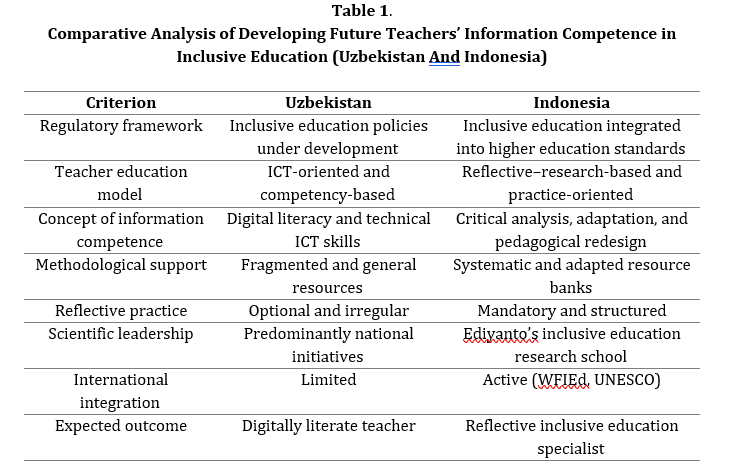
This study investigates the development of future teachers’ information competence in inclusive education settings through a comparative analysis of Uzbekistan and Indonesia. Information competence is conceptualized as an integrative construct comprising cognitive, operational–practical, motivational–value, and reflective components. Using theoretical analysis and comparative pedagogy methods, the research highlights significant differences between national teacher education models. The Indonesian experience, particularly the reflective–research-based approach advanced by Professor Ediyanto Ediyanto at Universitas Negeri Malang, demonstrates a systematic integration of information analysis, adaptation, and pedagogical decision-making. The WFIEd framework is positioned as a mechanism for international methodological alignment. Based on the findings, the article proposes evidence-based recommendations for improving methodologies for developing information competence among future teachers in inclusive education contexts.
Downloads
References
Anderson, T., & Dron, J. (2011). Three generations of distance education pedagogy. International Review of Research in Open and Distributed Learning, 12(3), 80–97.
https://doi.org/10.19173/irrodl.v12i3.890
Bates, T. (2019). Teaching in a digital age: Guidelines for designing teaching and learning. Vancouver: BCcampus.
Bell, D. (1973). The coming of post-industrial society. New York: Basic Books.
Booth, T., & Ainscow, M. (2011). Index for inclusion: Developing learning and participation in schools (3rd ed.). Centre for Studies on Inclusive Education.
Creswell, J. W., & Poth, C. N. (2018). Qualitative inquiry and research design: Choosing among five approaches (4th ed.). Thousand Oaks, CA: SAGE Publications.
Ediyanto, E. (2018). Teacher readiness for inclusive education in Indonesia. International Journal of Inclusive Education, 22(7), 734–748.
https://doi.org/10.1080/13603116.2017.1412510
Ediyanto, E., & Kawai, N. (2023). The measurement of teachers' attitudes toward inclusive education: An empirical study in East Java, Indonesia. Cogent Education, 10(2), 2229014. https://doi.org/10.1080/2331186X.2023.2229014
Ediyanto, E., Kustawan, D., & Suryani, N. (2020). Developing teachers’ reflective competence for inclusive classrooms. International Journal of Inclusive Education, 24(9), 987–1003.
https://doi.org/10.1080/13603116.2018.1514750
European Agency for Special Needs and Inclusive Education. (2018). Teacher education for inclusion. Brussels.
Khimmataliev, D. O. (2022). Developing professional competence of future teachers in inclusive education settings. Pedagogical Education and Innovations, 4(2), 15–22.
Khimmataliev, D. O., & Omonova, N. P. (2023). Developing information competence of future teachers in a digital inclusive learning environment. Modern Education, 6(1), 28–35.
Méndez, V. G., Suelves, D. M., Méndez, C. G., Ramon-Llin Mas, J. A., & Romero, J. (2023). Future teachers facing the use of technology for inclusion: A view from the digital competence. Education and Information Technologies, 28, 9305–9323. https://doi.org/10.1007/s10639-022-11105-5
Meyer, A., Rose, D. H., & Gordon, D. (2014). Universal design for learning: Theory and practice. Wakefield, MA: CAST.
OECD. (2019). Trends shaping education 2019. Paris: OECD Publishing.
OECD. (2021). Digital education outlook: Pushing the frontiers with AI, blockchain and robots. Paris: OECD Publishing.
Omonova, N. P. (2021). Methodological foundations of teacher activity in inclusive education. Special Pedagogy and Psychology, 3(1), 41–48.
Omonova, N. P., & Khimmataliev, D. O. (2024). Developing future teachers’ information competence in inclusive education contexts. Journal of Engineering Science and Technology, 19(2), 112–123.
Robert, I. V. (2014). Information educational environment: Theory and practice. Moscow: BINOM.
Sahlberg, P. (2015). Finnish lessons 2.0: What can the world learn from educational change in Finland? New York: Teachers College Press.
Schön, D. A. (1983). The reflective practitioner: How professionals think in action. New York: Basic Books.
UNESCO. (2017). A guide for ensuring inclusion and equity in education. Paris: UNESCO Publishing.
UNESCO. (2020). Global education monitoring report: Inclusion and education – All means all. Paris: UNESCO.
World Federation of Inclusive Education (WFIEd). (2021). International guidelines for inclusive teacher education. WFIEd Publications.
Zenkina, S. V. (2016). Information and communication educational environment as a pedagogical system. Pedagogika, 5, 34–42.
Additional Files
Published
How to Cite
Issue
Section
License
Copyright (c) 2026 Authors

This work is licensed under a Creative Commons Attribution 4.0 International License.
Similar Articles
- Syifa Adilla Zahra, Syifaul Karima, Nur Rohfitta, Ainal Gani, Guntur Cahaya Kesuma, A. Fatoni, The Social Education Values in the Qur'an, Surah Al-Hujurat, Verses 11-13 , Action Research Journal Indonesia (ARJI): Vol. 7 No. 4 (2025): Action Research Journal Indonesia (ARJI)
- Nizma Armila, Abdus Salam DZ, Dian Widiantari, Application of Prophetic Democratic Leadership Mudirah at Pondok Pesantren Tahfiz Putri Khoiro Ummah Yogyakarta , Action Research Journal Indonesia (ARJI): Vol. 6 No. 4 (2024): Action Research Journal Indonesia (ARJI)
- Vera Sapitri, M. Nurudin, Muhammad Arham Prasetyo, M.Yusuf Qordowi, Muhammad Hafiz Putra, Nurul Azizah, The Relationship between Flexible and Adaptive Behaviour Ability and Students' Tolerance Attitude: A Correlational Approach , Action Research Journal Indonesia (ARJI): Vol. 7 No. 2 (2025): Action Research Journal Indonesia (ARJI)
- Pitra Gosha Patriasya Nurul, Hauzzan Felgiansyah, Intan Indah Maharany, Endhah Tryadumawati, Jeny Almira, Nurul Azizah, Team Assisted Individualization: Efektivitas Model Pembelajaran Cooperative Terhadap Minat Belajar Peserta Didik , Action Research Journal Indonesia (ARJI): Vol. 7 No. 3 (2025): Action Research Journal Indonesia (ARJI)
- Dewinarto Nainggolan, Rina Octavia Simarmata, Fenty Debora Napitupulu, An Error Analysis of Inflectional Affixes in Writing Analytical Exposition Text on Students at SMAN 3 Medan , Action Research Journal Indonesia (ARJI): Vol. 7 No. 2 (2025): Action Research Journal Indonesia (ARJI)
- Nakhma’Ussolikhah Nakhma’Ussolikhah, Muhammad Iqbal Al Ghazali, Mohamad Mizan Sya'roni , Analysis of Child Development in the Home Schooling Learning Process from an Islamic Boarding School Perspective , Action Research Journal Indonesia (ARJI): Vol. 5 No. 4 (2023): Action Research Journal Indonesia (ARJI)
- Pitra Gosha Patriasya, Syahidin Syahidin, Sinektiks: Revitalisasi Kreativitas Peserta Didik dalam Dinamika Pembelajaran Pendidikan Agama Islam , Action Research Journal Indonesia (ARJI): Vol. 7 No. 4 (2025): Action Research Journal Indonesia (ARJI)
- Millatus Shofi, The Use of Crossword Puzzle Media in Fiqh Learning at Mts Nurus Syafi’i Gedangan Sidoarjo , Action Research Journal Indonesia (ARJI): Vol. 7 No. 4 (2025): Action Research Journal Indonesia (ARJI)
- Risa Nalwi Fatimah, Baharudin Baharudin, Wan Jamaluddin Z, Imam Syafe’i, Umi Hijriyah, Zahra Rahmatika, Mohamad Fauzan Adima, A Bibliometric Analysis of Islamic Parenting Trend in Indonesia , Action Research Journal Indonesia (ARJI): Vol. 6 No. 4 (2024): Action Research Journal Indonesia (ARJI)
- Muhammad Iqbal Al Ghozali, Khoerul Umam, Luqman Ardiyanto, Penggunaan Media Map Mapping berbasis Model Small Group Discussion dalam Meningkatkan Hasil Belajar Mata Pelajaran Bahasa Indonesia Siswa Kelas V di MI Al-Washliyah Perbutulan , Action Research Journal Indonesia (ARJI): Vol. 4 No. 1 (2022): Action Research Journal Indonesia (ARJI)
<< < 5 6 7 8 9 10 11 12 13 14 > >>
You may also start an advanced similarity search for this article.
Most read articles by the same author(s)
- Nilufar Parda Qizi Omonova, Developing Information Work Competence of Future Primary Education Teachers: An Integrative Pedagogical Model , Action Research Journal Indonesia (ARJI): Vol. 8 No. 2 (2026): Action Research Journal Indonesia (ARJI)
|
Support > Partner > Tools > Indexing
|
Contact > Adrees > Website |
Statistic |
For Author > Template
|
 |
|---|

Creative Commons Attribution-ShareAlike 4.0 International License CC BY-NC-SA 4.0 |