Author Guidelines
GENERAL FORMAT OF WRITING
The Initiative Journal Template follows the APA style. The manuscript is typed on standard A4 sized paper (21 cm × 29.7 cm) in one column format.
Margins 19mm, 25.4mm, 19mm, 25.4mm (Left-top-right-bottom), using Book Antiqua font size 12pt with left-right alignment.
Manuscripts are written in Indonesian with a minimum length of 5 pages.
Pages, including references and attachments must be numbered sequentially.
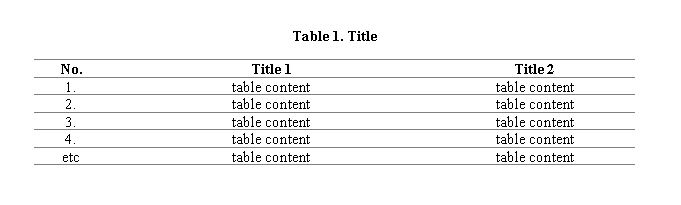
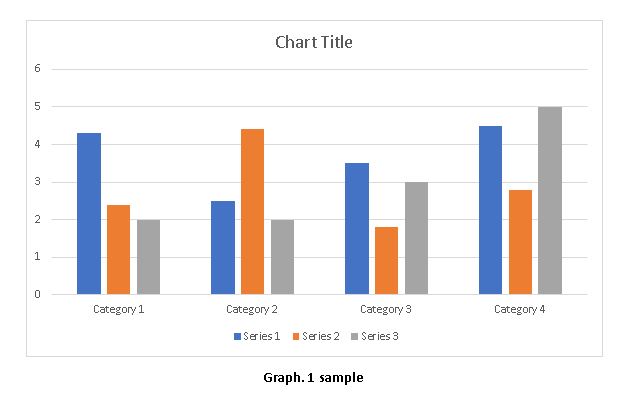
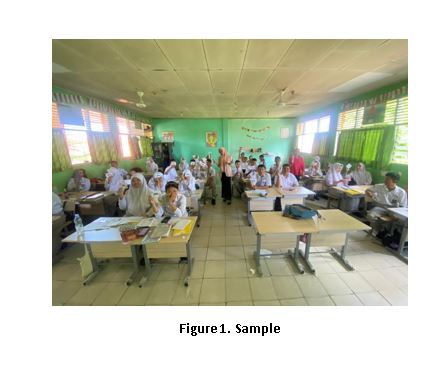
Each table or figure is numbered sequentially. The title of the table must represent the contents of the table and figures written in the middle. Sources of Tables and Figures must be listed.
ABSTRACT
Consists of 150 to 200 words, written in English and Indonesian, in one paragraph containing: a brief description of the partner's problem, the purpose of the service, the method of activity, and the results of the activity. Typed in Times New Roman font, single spaced, and italicized. Under the abstract there are keywords, a maximum of 5 words, separated by semicolons, typed double space below the abstract
INTRODUCTION
This section contains an analysis of the situation, partner problems, and the solutions offered. Situation analysis depends on the target community. Analysis can be in the form of a description of all the problems faced by partner communities from social, cultural, religious, health, quality of service or community life aspects. It can also be in the form of business potential and opportunities for partner communities from the aspects of resources, production and business management.
SERVICE METHODOLOGY
Describe how cases/locations (material objects) were selected. Describe the type of service (ABCD, PAR or other types of service). The description of the implementation of the activity includes the location, time, background of the participants and the number of participants. While the description of the activity method includes the method and material presented. Choose one or combine several activity methods, including: (1) Training/Training: goods or services, science and technology diffusion, science and technology substitution (renewable science and technology), or science and technology simulation; (2) Continuing education; (3) Awareness/Increased understanding of a problem; (4) Consultation/Assistance/Mediation.
RESULTS AND DISCUSSION
This section is the main part of the devotional article and is usually the longest part of an article. The results of the dedication presented in this section are "clean" results. The data analysis process does not need to be presented. Tables and pictures can be used to clarify the presentation of the results of the service. Tables and figures must be commented or discussed. The discussion in the article aims to: (1) show how the solutions offered are implemented to address partner problems; (2) shows how the outcome of implementing the solution is an indicator of program success; and (3) explain the factors driving or inhibiting the implementation of the program. In this section of the discussion, more emphasis is placed on the description of program outputs which can be in the form of products/goods or services produced by partners as indicators of program success. In answering partner problems, the results of community service must be measurable (before activities and after observing the products produced, partners' responses, and so on).
CONCLUSION
Conclusions are made concisely, clearly and concisely based on the results and discussion, made in the form of paragraphs.
BIBLIOGRAPHY
Manuscripts are written using standard citation applications (Mendeley/Endnote/Zotero). APA (American Psychological Association) reference style with last edition.